
hero image spiritual connection

In 2020 I released an Audible Original about how to live a spiritual life by tapping into your own inner wisdom. It was called You Are the Guru. The audiobook came out right after I received the heartbreaking news … 

Yet again, one of my so-called gurus had been exposed. This person had committed horrific crimes.

I was devastated. 

Though I’d acknowledged this experience on social media, I’d never felt comfortable talking about it publicly … until today’s episode of the Dear Gabby Podcast.  

For this Big Talk, I sat down with Rainn Wilson and Reza Aslan … and the floodgates opened.

spiritual straight talk

These guys are deeply committed to their own spiritual and religious faiths. And in their calm, steady presence, I felt comfortable opening up about the shame of making someone my “guru” … only to have them fail me. 

This episode is deep. 

We had the most beautiful conversation about witnessing faith in action and infusing spirituality into everything you do. 

We also had a few good laughs …
booblehead

joy is the through-line

This Big Talk covers so much ground…

in this episode you’ll hear about:
  • Using joy as a through-line to integrate every part of your life—even if you’re on a slightly scary Uber ride. I’ll share how I turned an uncomfortable moment into an opportunity for joy. 
  • Demystifying what it means to be a person of faith. As Reza said, “Living a spiritual life is an active choice—there’s nothing magical about it. Being a person of faith is a decision that you make.”   
  • The power of humility. Here’s what Rainn said about humbling ourselves to pray: “Prayer is an ability to say I need help. And there is a beautiful, bountiful, power coursing through this Universe that can help me along my journey—if I attune to it.”  
  • How to approach therapy as a spiritual practice. (I LOVE what Rainn had to say about this!)  
  • Why service to others is integral to spiritual growth. “You can’t just sit in your walled garden and become more spiritual staring at a tree or a crystal with some incense burning,” Rainn said. True spirituality  also means “Serving others, connecting with others and trying to make the world a better place.”

healing the spirit

We also touched on addiction and the trauma that underlies so much of it. Even socially acceptable addictions, like workaholism, are often rooted in trauma. 

I know this intimately.

Another big moment of this episode is when I open up to Rainn and Reza about my past as a workaholic. Because I was terrified—of my body, of my life, of everything! I was unable to sit in stillness. I would work, work, work to anesthetize the pain.  

when we are willing to look at the root causes of our addictions, we can become free

And that’s how I have freed myself from all the addictive patterns in my life … and learned to be at peace by just being myself.

^^Rainn, Reza, and I dug into that concept on Dear Gabby

spiritual practice

I also explore it in my book, Happy Days: The Guided Path from Trauma to Profound Freedom and Inner Peace. 

In the book, I share my own personal story of overcoming trauma. I go into detail about the 9 tools I used to heal. These include some of the practices that we discuss on today’s Dear Gabby, such as Internal Family Systems therapy

As Rainn said in this Big Talk, “What we call therapy is a spiritual practice as well.” 

I deeply resonate with that.

spirit is in everything

I believe that Spirit is in everything. It’s in books; it’s in a yoga studio; it’s in kittens and kids. You can find spirit in a therapist, or in a medical prescription, or through a 12-step program. 

>>>But most of all, Spirit is in you. It’s in your thoughts, your actions, and everything you do—whether you’re at an ashram or on an Uber ride. 

Remember, You Are the Guru. You can make faith an active choice and pursue a spiritual connection of your own understanding. 

You can decide how to see the world and how to show up in it. 

And you can develop a spiritual foundation that’s so strong, it will always be there for you like a giant pillow …. ready to catch you if you fall. 

Living a spiritual life means staying in spirit and leaning into faith, no matter what happening around us.

gabby

I hope this episode of Dear Gabby inspires you to infuse more spirituality—and more joy— into everything you do! I can’t wait for you to listen. 

Oh, and if you want to hear what the word “guru” translates to, click here. This is so cool! 

get more gabby

free meditation for connecting with your spirit guides

By submitting your number, you agree to receive recurring automated promotional marketing text messages from Dear Gabby, Inc. and Gabby Plus, Inc. at the cell number you entered above. Consent is not a condition of any purchase. Reply HELP for help and STOP to cancel. Msg frequency varies. Msg and data rates may apply. You also agree to our Terms & Privacy Policy.

disclaimer

This podcast is intended to educate, inspire, and support you on your personal journey towards inner peace. I am not a psychologist or a medical doctor and do not offer any professional health or medical advice. If you are suffering from any psychological or medical conditions, please seek help from a qualified health professional.

dear gabby #44 Jan 31, 2022 spiritual connection 51 min

how to live a spiritual life

Listen on:

The following podcast is a Dear Media production.

Hey there. Welcome to Dear Gabby. I’m your host Gabby Bernstein. And if you landed here, it is absolutely no accident. It means that you’re ready to feel good and manifest a life beyond your wildest dreams. Let’s get started.

Do you ever have super heady conversations with your friends about metaphysical principles and spiritual practices?

My guess is that if you’re listening to Dear Gabby, you either do have those conversations or you want to be having them. Today I have this awesome opportunity for you to listen in on a conversation that is exactly my type of convo. This is exactly what I want to be talking about with the same type of people I want to be talking to.

It’s a super heady conversation about spirituality, faith, and all of the things that I know to be true. All of the belief systems that I have devoted my life and my career to. And all of the principles that we talk about here on Dear Gabby, strengthening our faith, our spiritual connection, how we become our own guru and all of the ways that we can deepen that faith through our own understanding, our own experience of it.

In this conversation. I talked to two guys that are so dope. I talked to my new friends, Rainn Wilson and Reza Islam. Rainn is someone who I’ve wanted to be friends with for a really long time. We have a lot of shared belief systems. We’re both in sober recovery for many years, and really thank our sobriety for all of the gifts that we have in our life today.

And Rainn is an actor. You probably know him best from his role on The Office. He also had a gorgeous production company called soul pancake that put up beautiful, mindful content. That was also extremely entertaining. Reza, who is my new friend and so cool—such a neat guy, is a renowned writer, commentator professor, Emmy-nominated producer and scholar of religions, a recipient of the prestigious James Joyce award. Rez is also the author of several books.

Both Rainn and Raza have a really cool podcast called the Metaphysical Milkshake. First of all, how good is that title of that podcast? Unbelievably amazing, the metaphysical milkshake. And these guys are so fun, but they’re also so deep and they’re so smart and they’re so authentic and open. Also, Rainn is really funny. They make some jokes about how Rainn is like the Jesus of their podcast and Reza is James Jesus’s brother, always having to do things for him.

It gets really funny. It gets really heady. It’s super spiritual, and this will be a beautiful conversation to listen into. In this conversation, we go deep into our own spiritual practices and what that means to us. We talk about what happens when we have a guru and the guru fails us and the disappointment and the suffering that comes from that.

We talk about how Reza identified an addiction that he didn’t even know was there. This is such a cool conversation. I do not want you to miss this; tune in now, and enjoy this dialogue. And what you’ll take away is that we all are spiritual beings having a human experience and that we all have the capacity to tune into a spiritual connection of our own understanding.

[AD BREAK]

GABBY: I’m really grateful that both of you are here right now. I’m really thrilled to be able to connect with two individuals who have a shared passion for metaphysical principles and religious principles and beliefs in spiritual practice. And I like to start with what that means to both of you. Let’s start with Reza and just hear a little bit about what it means to be in communication with a spiritual religious connection of your own understanding.

REZA: I think for me, spirituality is more than just kind of a, a lifestyle. It’s a kind of mode of being. Like, it’s a way of looking at the universe. It’s a, it’s a point of view in other words, right. I don’t see it as kind of separate and distinct from, you know, regular life.

I think so many times people categorize spirituality is a kind of a unique category. That’s different from say the secular, right? We do this all the time. Like there’s the secular and the profane, you know, there’s the, and there’s the sacred and you know, the spiritual, but it’s all very integrated—my life. Partly, this has to do with, you know, the way that I understand our human capacity for spiritual thinking to function.

Right. It’s and I’ve written a lot about this, but it’s the religious impulse, you know, impulse towards spiritual thinking is deeply embedded in our brain. You know, it’s part of the way that our cognitive processes work. It’s a brain function, if you will. And so. I feel like it’s there for a reason, because it’s meant to be tapped into.

We are fundamentally spiritual beings that part of the full expression of being human is tapping in to that ability to feel transcendence, to think about and experience that which is beyond this kind of material realm. I think it’s just kind of part of the human condition, right. It’s who we’re meant to be as human beings.

And so I try very hard to integrate spiritual thinking into my everyday life. Right. Instead of thinking about it as kind of a separate and distinct category, you know, and, uh, and that’s, that’s kind of, that’s really served me, I think, especially as I’m getting older and, you know, having less time to do things, it’s hard to believe.

GABBY: He looks real good.

RAINN: You’re like a silver Fox.

GABBY: With perfect skin.

RAINN: But in a body of like a 22 year old.

REZA: But the bones of an 80 year old.

GABBY: That’s when you want to remind yourself that you are a spirit having a human condition.

REZA: Exactly. So. Yeah. And I think, you know, it’s, it’s harder to, to meditate. You know. I have four kids. It’s hard for us to all get up and go to church or whatever. And so it’s all about integrating spiritual thinking into every day life and practice, you know, I think that’s kind of the key for me.

GABBY: I like what you’re saying, because I’ve always said that if there isn’t a spiritual part of my life, this is my spiritual life.

I live a spiritual life. I don’t even think I need to make that as an intention anymore. It’s infused in every corner of everything that happens. Every thought I have, every intention I set and. I know very quickly when I’m misaligned. Right. That’s a beautiful way to consider life is just being in spirit no matter what is happening around us and leaning into that, no matter what.

And I think a lot of that comes with conditioning. I only say conditioning because, you know, you mentioned that, you know, there’s this biological condition of wanting or needing to be in connection to spirit. But it’s often the thing that we look for in all the wrong places. We’re often looking for that connection, that intuition in a lot of the wrong places.

So I’d like to bring that to you, Rainn because I think when we’re in that pursuit of a spiritual connection outside of ourselves, that can really obviously take us down, but also can be the greatest moment of awakening. And I, I love the Rumi quote. The wound is the place where the light enters you. So I’d love to just hear how maybe having those breaking moments or bottoms were maybe a catalyst for you to connect to spirit and what that means to you now.

RAINN: Yeah, sure. Thanks so much Gabby. And I love that you’re having these discussions and I love being a part of them and that connection, you know, between it’s so hard to draw the line like where’s self-help and where’s spirituality and where’s philosophy and where’s psychology, where it’s all united, you know.

GABBY: I think it’s all the same potentially. I mean we can get into that, keep going.

But I want to maybe we’ll come back to.

RAINN: Yeah, no, I, but I, I agree. I think it’s all, it’s all the same. It’s all different slices of the same pie, which is the human experience. And, you know, you, you quoted, you know, Pierre Teilhard de Chardin—we’re not human beings having a spiritual experience. We’re spiritual beings having a human experience.

You know, for me when I really realized that, so I grew up a member of the Bahai faith, and I’m a practicing member of the Bahai faith right now. That’s my religious tradition, but I left it hard in my twenties. Like so many people in their twenties do to go kind of find myself in the big city and, and had a lot of great times, but also had a lot of really, really difficult times.

And when I look back at what I went through, I realize now that we didn’t have the vocabulary then that we do now around mental health, but I really was going through a mental health breakdown, would have debilitating anxiety attacks that would literally leave me shaking on the floor. I was in severe depression, uh getting treatment for that.

But no one talked about you’re having mental health issues. I was deep into addiction. I was really poly addicted. Pretty much anything you could kind of get addicted to. I was just trying to use, like you said, soothe and escape that wound and trying to connect in unhealthy ways. But at the same time, when I look back on it, I’m so grateful for those experiences.

It forced me into therapy. It forced me to kind of rethink my spiritual life. It got me back in touch with my faith and to kind of set me on a journey, which has been a flawed journey. It’s not like I’ve got it all figured out and something we were talking a little bit about before this started Gabby, which was and Reza kind of tipped his hat to it, which is not separating a spiritual practice from a daily practice of being a human being.

Because if we’re spiritual beings having a human experience, everything we do in some way, shape or form can and has to reflect the spiritual.

GABBY: Totally.

RAINN: So my whole mission in the last really 10 years or so of, of real sobriety has been to integrate all of this stuff. Like I’m Dwight on The Office that he plays this kind of comic weirdo, but he’s a Bahai and he’s interested in life’s big questions.

You know, uh, and, and I’ve got my family life and I’ve got my hobbies. And how does all of that fit together where I’m just this radiant trying to be attempting to be radiant, a spiritual being, living my most fulfilled, possible life. And it’s, um, it’s, it’s a difficult journey, but it’s an exciting one.

GABBY: Well, I think they all fit together in a cool way because when we have this unconscious or conscious, depending on where you’re at and what you think on a day-to-day basis, but this unconscious desire to be in connection with spirit, which ultimately to me means to, to feel love. To dwell in the energy of love and joy.

And when that’s the through line and it shows up here when I’m with you guys and it’ll show up when I’m with my three-year-old and it’ll show up when I’m in an Uber with some guy that’s like, you know, driving too fast and I’m bringing the joy and Hey man, can you just slow it down? Like what happened this morning?

You know, but being in the presence of that joy and that love no matter where you go can be that through line between who you are on The Office and who you are as an actor and who you are on your podcast and who you are as a friend and who you are as a family member. And for me, I’ll just speak for myself.

And I’d love to hear what your theory on this is Reza, but like when we make that primary intention, which is to lean towards joy, to, to be in love, to be a spiritual being that it ultimately can be the thread between all of the different parts that we play in our life.

REZA: What I really love about what you’re saying is the aspect of personal choice in the matter.

Like, I think we all know people, we all have friends who say things like, you know, I wish I, I wish I was a spiritual person. I just, you know, I just can’t, I just don’t, you know, Those of us who have like an active spiritual life we’re, you know, struck by lightning or something. And so it just, it just happened.

It’s like, no, it’s an active choice. Right. And this is the thing that I kind of say to people all the time that, you know, being a person of faith or, um, having a spiritual perspective is nothing more than just kind of a decision that you make. Right? That you just sort of decide like, this is how I’m going to see the world and there’s nothing magical about it.

Right. It’s it’s not just some like, you know, accidental thing that happens at some people get in some people don’t, you know, it’s just. How do you choose to go through your day? Do you, you know, do you choose to sort of think about the world as being nothing more than material or do you, are you actively striving for a different kind of experience?

And, you know, just like you were saying in your Uber drive, like, do you, you consciously decide to kind of bring joy into the car? It doesn’t have to be much more complicated than that.

GABBY: Yep, exactly. And I really liked that. You’re just unpacking it and demystifying it.

[AD BREAK]

GABBY: Anyone that’s listening to this podcast or listening to Metaphysical Milkshake, best podcast title would be in some way seeking that connection. And unapologetically seeking that connection. If you’re going to press play, if you’re still listening right now, you’re, you’re looking, you’re, you’re seeking or you’re open.

And so that’s enough that, that I always say that happiness is a choice we make. And I think that means our spiritual practice is a choice that we make. Our sobriety is a choice that we make, our day to day showing up in recovery at any form, as this is a choice that we make, that brings me to sort of religion and practices and gurus.

And I just have this desire to ask you guys a question. I’ve always, I’ve been a spiritual seeker my whole life. And when my mother would bring me in and out of, um, ashrams and I was taught to meditate as a child, and I had this spiritual foundation.

And then as a spiritual student on my own, in my sobriety and my sober recovery in my pursuit of, of strengthening my own faith and my life practice of being a spiritual woman, I’ve known that I was guided to different practices and teachers and self-proclaimed gurus at different times for my own awakening.

But in two instances that are really quite heartbreaking, two big name gurus that I became wouldn’t want to say like a follower, or a devotee, but like really took the principles. They changed my life. And changed my, my relationship to my own spiritual connection turned out to be really fucked-up dudes.

Right. And so. And I’m not even sure if I want to bring up their names. That’s how like triggering it is for me. Right. It’s triggering because it was these two different practices that were very impactful in my life. And I was very vocal about them and I’ve had to rewrite books of mine to write them out of it, you know, and rerecord audio to get them out of the audiobooks, because there were such shameful things that these guys did.

So I just want to hear what your feelings are about going down the path of following a specific quote unquote guru. And I think there were gurus a bunch of bullshit, just because I think I wrote a book called, You Are the Guru that we all have to find that within ourselves.

REZA: Rainn is my guru.

GABBY: Rainn can be our group truly, but other than Rainn, other than Rainn, we really should be our own guru.

RAINN: And I’m soliciting donations. Go to: Rainn guru.com. Rainn guru.com. For the low, low price of $1,200 a week.

GABBY: I’ll send you lots of books and CDs that you can stack up in your closet. Okay. Rainn, tell us, tell us what that means to you. I mean, or if you guys have any advice for me on how to process this stuff, but yeah. I just want to hear from you about what, you know, what happens when we kind of follow a path that’s really disappointing.

RAINN: Well, thanks for sharing that. And I’m really sorry to hear that. The stories that’s really terrible. Um, anyone who is given a kind of the spiritual charge to be a leader in a spiritual community and help guide people that are looking for answers, uh, they have an incredible trust. You know, it’s like a, they’re a teacher and they break that trust, which happens a lot.

It’s um, it’s, it’s, it’s, it’s horrific. I mean, it’s one thing, if it’s your accountant or other thing, if it’s someone you’re looking for guidance. So first of all, I think a lot of people that go into this world have had some trauma and have some brokenness in them and that they’re seeking to rectify. So a lot of people then.

Uh, the ego is a very powerful monster and, uh, narcissism goes hand in hand with guru-dom. How could it not? I mean, how could you not sit in front of a group of hundreds of people and they’re all looking at you and hanging on your every word and how could that not affect you? You know?

And, and I think that can, you can easily lead a double life and it can easily lead to, uh, you know, this kind of egotistic narcissistic life.

And that’s why I love that. You’re saying that we are our own gurus because everyone is flawed. You know, we’re just such flawed, broken, wonderful, lovely, terrible, delightful, idiotic, brilliant people, you know, we’re just filled with so many contradictions and that’s okay. And, and, you know, for me specifically, One of the reasons I love my faith Bahai faith is, um, I’m not really not trying to plug it, but I’ll just share my experience.

Yeah. My experience is there’s no clergy in the Bahai faith. And in fact, I think it’s got to be the world’s largest religion that doesn’t have a clergy, you know, there’s no, there’s no rabbis or mullahs or. Or priests or, or anything like that. So it’s all, it’s, it’s a little bit like a 12-step program in that the inmates are running the asylum.

GABBY: Totally.

RAINN: Which can have its own set of challenges, but it it’s really beautiful in that way because it’s grassroots and, you know, the only guru is, is God, you know?

And so that means a great deal to me in my personal spiritual practice.

GABBY: I love the idea of the community-led. Reza, I want to hear from you because you’re the guru of religious studies, but just, you know, you’ve obviously gotten so familiar with so many different types of religions. And I just want to hear from me what your experience has been in, in, has there been any disappointment or sense of, of loss in your connection to any practice?

REZA: I mean, in general, I have kind of, you know, a general distrust of people anyway, distrust dislike of people anyway. So I’ve never, ever kind of felt the, you know, the sort of temptation to be enthralled to anyone really. And I think also intellectually, because, you know, I’ve studied so many of the great prophets of the world, you know, and I’ve, I’ve written about Jesus and Moses and Muhammad and Buddha.

And when you sort of look at these great prophetic characters you would, what you see is human beings, right? Flawed human beings. And so if you can see that in these uh, people who have been elevated to almost divine status, then you immediately sort of approach gurus or religious leaders with a healthy dose of skepticism anyway.

GABBY: Yeah.

REZA: So it’s never really been a thing for me, but spiritually. I have to admit that I’m, you know, I recognize that spirituality, religion, that one of its greatest contributions to an individual is the creation of community, right. That it gives you this, this sort of your own collective to talk about things that are very difficult to express and you get this language that, you know, only you yourselves and your group understands and you get the shorthand for, you know, expressing to each other, the most mysterious ineffable parts of the human condition.

I have never been in need of community. I’ve never really sought out community. So yeah, I’m the wrong person. I’m the wrong person to ask about this stuff because I, I just have never been that person. My personality has never been the kind of personality that seeks out other people in general, but certainly other people from whom, you know, to receive spiritual instruction, it’s just never been my thing.

And I think I really do think it is, it does have to do with a lifetime. Um, deep historical analysis of like the greatest spiritual teachers in human history. You know, once you, once you find the flaws in Jesus, you’re like, well, I’m not going to trust anybody at that, but that’s how it really wasn’t.

RAINN: Wasn’t Jesus on the cross saying, God, why, why has thou forsaken?

REZA: Right!

RAINN: If. You know, so, I mean, I believe in the divinity of Christ and his special station as a high, but you know, that’s such a human moment of being like you’re being tortured. You’ve been through the ringer and you’re like, come on, God, come on, dad.

You know, what’s going on? And I think we’ve all been at that moment on our knees. Like, why have you forsaken me? Why am I going through such pain? What is going on? Yeah. I mean, one moment.

REZA: The Jesus of history was frequently angry, often annoyed, sometimes wrong and impatient. And you know, all the things that you would expect from a human being, even the human being who has been touched by God.

And so again, like once you, once you understand that, then it’s very, very hard to take sort of claims of you know, some kind of spiritual exceptionalism from individuals nowadays, to be honest.

GABBY: Yeah. And it’s so interesting that you said is because some of what was so heartbreaking for me when these gurus fell so hard was not so much about them.

Like one of them wasn’t even alive, you know, it was just a guy that was like a figure in a yoga practice, but was that the community that I fell in love with was so flawed, right? By, by knowing these truths and not just being, and just not being forthcoming about them. Like, this is really what happened, but we still believe in this practice.

Right. And so that, I think it’s like, it’s like the fall of the community was so much more heartbreaking than the fall of the person. And so that, that, you know, I just wanted to kind of close on that part.

[AD BREAK]

GABBY: But the thing I also want to talk about with you guys is spiritual bypassing, because I had an interesting conversation.

I’ve been studying internal family systems therapy, IFS. I’m in their level one training. And it’s something that’s back to what we said originally Rainn about how therapy and psychology and religion and spirituality have this, this through-line. I mean, I think that IFS is a true spiritual practice while it’s known to be this clinical therapy.

But what I was talking about with, with Dick Schwartz was how people often spiritually bypass is almost like another form of addiction of getting higher above the problems rather than going and facing the truth of what’s up. And I, you see this a lot in, in, in, in different spiritual practices and different religions as well when people are just using the, the religion or the spiritual practice to get above the root cause condition, just riff on that.

What that means to you, if you’ve experienced that, or if that’s something that’s ever been in.

RAINN: The only thing that pops into my head about what you’re saying. That’s wonderful that you’re studying that that’s super, super cool. I think…

GABBY: Are you familiar with ifs? Do you know, do you know…

RAINN: I’m not, I’m, I’m familiar with IBS irritable bowel syndrome. This is a little different, that’s better than that.

GABBY: This is a lot better than IBS. But you might, but stress would be a guide to IFS the same way it would be a guide to IBS.

RAINN: Well, the only thing that I’ll say is that I think this all comes back around to kind of the thesis of our conversation, which is that spirituality is not something that’s for church on Sundays.

It’s not something for yoga class. It’s not something for just when you’re meditating and it can be folded into everything that one does in one’s life and processing family pain and trauma and, and dynamics of communication. You know, kind of what we call therapy is, is a spiritual practice as well. And some of that is very nitty gritty.

It’s not kind of, for lack of a better phrase, airy fairy, you know, it’s, it can be setting hard boundaries with family members. You know, that can be a spiritual practice to say, Hey, it’s not okay for you to do X, Y, and Z. When you come into my house, you know, and examining the trauma that we underwent and, you know, and addressing that with our parents or our siblings.

It’s very, you know, it’s very meat and potatoes stuff, but it’s so important to our spiritual progress.

GABBY: It’s a soul retrieval truly going through any kind of trauma recovery. I think back to the conversation we were having about how spirit is in everything. I believe that that spirit is in the therapist. Spirit is in the medication. Spirit is in the 12-step rooms.

RAINN: So crew comes from the two syllables. They say, Gu is like darkness and Ru is dispeller. So darkness disspeller is a guru. So if your therapist is a darkness disspeller, then that can be your your guru, right? Like that. But listen, we did an episode with Dr. Gabor Maté, who was the most incredible addiction recovery, spiritual specialist.

Uh, philosopher you’ll ever meet. And he diagnosed Raza in the most crazy, in the craziest way. And it was it’s in this episode of Metaphysical Milkshake that, because Reza doesn’t, God bless him. Doesn’t suffer from addiction so much, but when he started probing, what happened there? Reza, do you want to, do you want to?

REZA: Well, he was, uh, I was talking about your Rainn has been very open about his various addictions and, and, uh, and there’s a big fan of Dr. Maté’s.

I was like, well, this is all intellectually fascinating for me. You know, this idea that addictions are tied to childhood trauma and sort of the need to like, you know, make up for the pain of that time and you know, all this stuff. And I was like, oh yeah, this is all very interesting intellectually.

But I mean, I have no emotional connection to it because it doesn’t, I don’t have any addiction.

And Gabor’s like, You sure about that? And I was like, oh, and Rainn kind of, you know, uh, outted me a little bit about the. You know, I’m a quote, unquote workaholic.

GABBY: And Gabor is a self-proclaimed workaholic.

REZA: Yeah. But that’s not a, that’s not a real thing. There’s no, that’s no quote, unquote dude, you know, come on. It’s true.

GABBY: And the problem is it socially acceptable and praised in this culture. So maybe you wouldn’t notice it.

RAINN: You get featured in Vanity Fair. If you, if you’re a workaholic like this guy has never seen his family. And made a billion dollars and works a hundred hours a week.

GABBY: Let’s talk about your workaholism. Okay. So how did it feel when Gabor said you’re a workaholic.

REZA: Yeah. And, uh, you know, he, he was like…

RAINN: And the trauma that underlies it.

REZA: Let’s talk about. And I made some comment, like, look, that’s not a real thing. That’s just called being an immigrant. You know, that’s like…

GABBY: Wow.

REZA: You know, my family fled Iran. You know, we came here with nothing and, you know, I just kind of what I learned. And even as I’m saying this, I’m thinking to myself, oh shit. I think, I think I’m starting to get where this is going and sure enough, he just like immediately tied it to like the trauma of that experience of being a refugee and sort of the need to make sure that like, there was always enough.

And now, you know, I have more than enough, but it’s like, I’m constantly like, okay, what’s the next thing. What’s the next thing. What’s the next thing. And so pressure in that.

RAINN: The family pressure for you to succeed in this world. And also Reza wanted to be a writer. He’s like, mom, dad, I want to be a writer. Like what. So he had to doubly prove himself in a field that his parents were like, oh Jesus.

REZA: Yeah. While also getting a PhD and becoming a professor, which was, you know, one of the approved professions that was, and I think, you know, it actually has affected me a lot.

Like I think about it a lot, actually, Rainn, you, and I haven’t really talked that much about it since the, since that episode, but it is at the forefront of my mind a lot, you know, where it’s like, I’ve always had this philosophy where you always say yes to everything. Right? Um, can you. I’ll just, yes, I can do that. I can do this.

I can do that job. I can do this. I can do it all. And just getting to the place where I feel comfortable saying no to an opportunity is completely a new experience, but you know, that’s, that’s a, that’s a big part of it, but I think this is the point where we should probably just admit that this podcast is just a way for us to get free therapy.

GABBY: Yeah, well, you know, listen, listen, I think that it’s really safe to say that most, every human has some form of addictive personality in some form, right? So it’s addiction to even, it could be like addiction to fear addiction to guilt or work addiction, debt addiction, whatever it might be. But it’s when the addictions are socially acceptable that they get really brushed under the rug.

And, uh, you know, I’m a recovering work addict as well. And people would say to me for years. Oh, wow. Gabby, you get so much done. You do so much little, did they know? It was like bad, horrible IBS, Rainn. I was, you know, so ill and so terrified in my body and in my life. And it’s, um, it’s, it’s beautiful that he was able to identify that in you.

And I think that, you know, Gabor was probably walking around like this one’s addicted to this when someone’s addicted to this, but without any judgment, because that is, I believe that we all suffer from some form of trauma with a big T or trauma with a small T and it affects our lives in very unique and innovative ways.

And when we become brave enough to look at those root cause conditions and the ways that they play out in our life, that’s when we start to become free in our life. And. And, you know, I can, I can say that in my sobriety it’s, it’s, it’s continuously showing up for those addictive patterns that has really continues to set me more free.

RAINN: And the universe will continue to test us in new and interesting ways as we proceed.

GABBY: Yeah. And I guess that’s where faith comes in, right? Because you, I just had a really rough experience a month and a half ago where I was, I was pregnant for five and a half months and sadly, I, I lost the baby. Wasn’t doing well.

This is just like a month ago. And I really, I, for 16 years, I’ve been in this field and I’ve been counseling people on grief and loss, and particularly many women who’ve had this type of loss. And here I was, and I was faced with my own teachings. And it was just beautiful to see my faith. I keep using this metaphor.

It was like, I could fall into it like a pillow. It was just so it was so effortless. And so I wonder if either of you have had those experiences of being two men who have been on this, you know, your own personal, spiritual quests to witness your faith in action. Now, what does that mean to you?

RAINN: I’ll jump in. So I think that a couple of things come to mind when you say that, thank you for sharing that story. And I’m really sorry about your loss. I’ve had many friends that have gone through that. And it’s, it’s one thing that it’s not really talked about culturally, you know, and it should be, I will say that two things.

One is that I think that the spiritual path of an individual has two branches. One is the person. And that is we’re growing and developing spiritual qualities in us to help us cope, to become better people. We want to become more radiant. We want to reflect the qualities of the divine, you know, humility, kindness, patience, compassion.

We’re developing these in ourselves. We’re seeking more inner serenity. And I think in the Western world, a lot of people are really focused on that branch of the spirituality, but there’s another branch. There’s another part of the practice of the spiritual, which is service. And that’s why 12 steps brings it all together in such a beautiful way, in a way that a lot of religions don’t because this idea of service to others is, is integral to spiritual growth.

You can’t just sit in your walled garden and become more spiritual staring at a tree or a crystal with some incense burning, you know. There can be important spiritual practices of meditation that can help you. But when you’re in, in the world, in the world, serving others, connecting with others, trying to make the world a better place, then you’re challenged, you know, and then you, you go back and you, and you meditate and you pray and you use those tools and that strengthens you.

And then you go back in the world and that gives you more propulsion to go back in the world and, and, and to serve more and help make the world a better place. Because there is a, there is a spiritual imperative to relieve the suffering of others. If you have truly have compassion in your heart, then it will kill you to have other people hungry, sad, homeless, destitute, oppressed, and we fight for them.

And so it is this it’s like a yin and a yang. It’s a circle it’s going inward going outward, outgoing, outward, going inward. It’s a constant process. And I will say that. So my spiritual practice works on both of those things. I meditate every day.

I pray every morning, but every day I try to in some way, shape or form, give back in some way and try and make the world a better place, whether it’s through nonprofit work or, you know, in helping people along their spiritual path or creating great Hollywood TV projects that are, you know, uh, you know, like Soul Pancake or podcasts that kind of uplift meaningful conversations.

But I do think that one thing, another thing. Is a little bit missing in the kind of, I would say the self-help new age community. And that is, and that is prayer. And a lot of people are very resistant to prayer because they grew up in churches and they had kind of a religious oppression and trauma, and they were like, oh, I don’t want to pray.

They have a vague idea of a higher power, but they don’t want to literally pray. But prayer is powerful. There is a force in the universe out there that is there for the wants to help us, but we need to get humble to it. Yeah. And that’s prayer is humility. An inability to pray is an inability to get really humble to say, I need help.

GABBY: Totally.

I need to help. And there is a big, beautiful bountiful power coursing through this universe that can help me along my journey if I attuned to it and just, just like, Jesus, God, why has thou forsaken me? To, just to connect with that, with that energy? There’s a very powerful force there that a lot of people aren’t using because they think it’s, oh, it’s a for born agains.

GABBY: Right.

RAINN: Born agains are the ones who pray. Yoga practitioners. We don’t pray, you know, so yeah.

GABBY: And sometimes it’s just the semantics that get people tripped up. So rename it, who cares? But prayer, uh, A Course in Miracles says prayer is the medium for miracles. I believe that my resilience in this recent experience of grief is a direct reflection of my commitment to daily prayer and communication with, with the spiritual realm and the communication with what I perceive to be guides and, and God and ancestors and the team truly.

And so I appreciate that that came back to prayer because how can you have a pillow of faith if you don’t have a foundation of surrender. Reza. What is, what does faith mean?

REZA: Rainn knows this cause I say it all the time at my, my absolute favorite Bible verse is from the book of James, which is my favorite book in the Bible written by my favorite character.

In all of, you know, Judeo Christian history, James, the literal brother of Jesus, which is crazy. Like imagine being Jesus, his brother. I mean, that’s not, I didn’t, I did not envy that guy.

RAINN: James, shut up. We want to hear what Jesus has to say, James. Okay. Got it. Just, can you sit back there? Jesus, talk more.

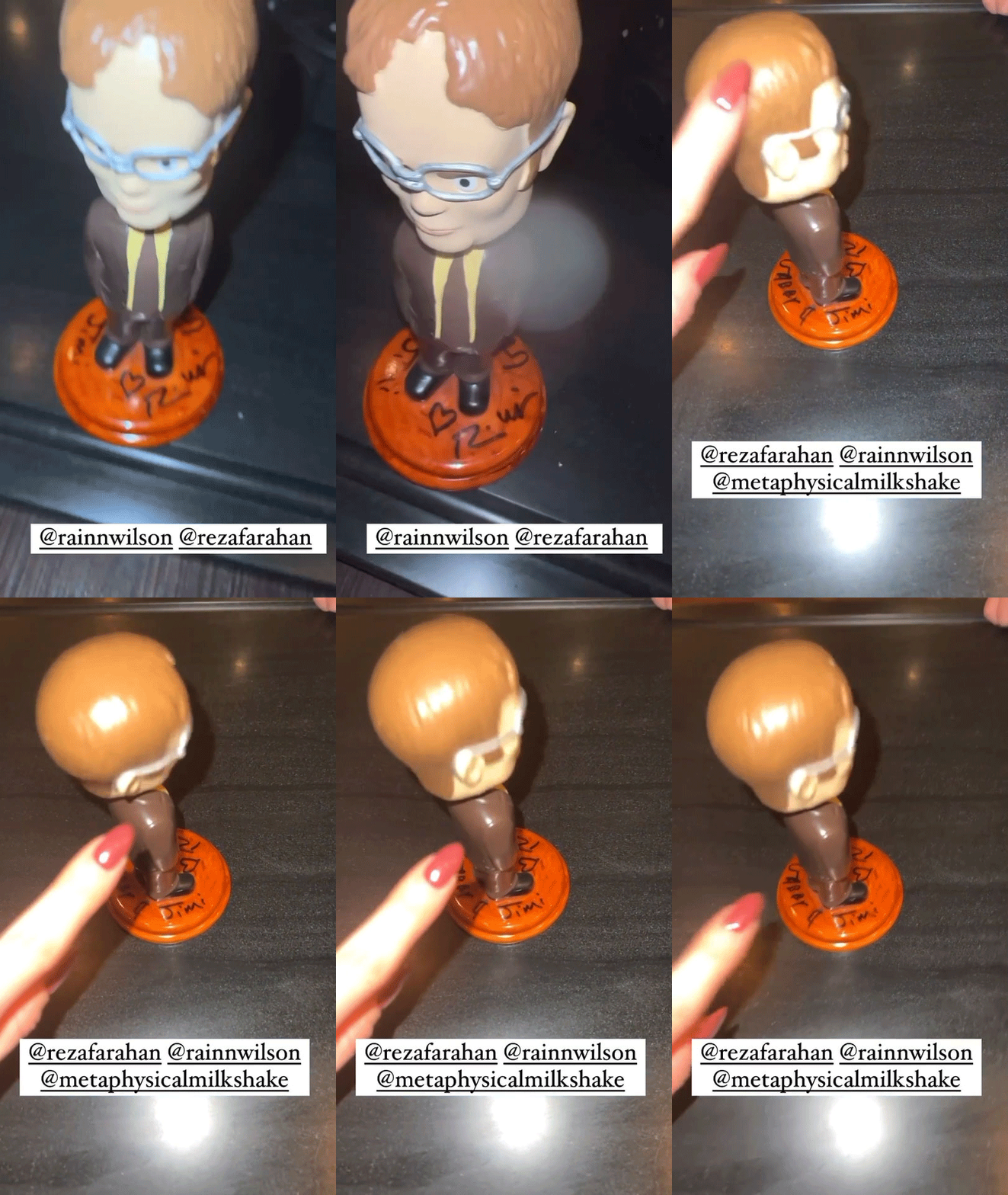
REZA: Could you imagine bunking with Jesus? God, we can get it, get it. Can you get Jesus to, uh, to heal my, uh, my broken toe? I just realized in a way I’m I’m the James of this podcast, people are always like, can I, do you think Rainn could, like, you know, can you send me like a photograph or something, or maybe one of those bobble heads?

GABBY: I actually want one of those bobble heads. Rainn, you can send me a bobble head?

REZA: James is a very, very interesting guy, real firebrand, you know, had a, had a vastly different view of what Christianity was supposed to be. This movement started by his brother, then what it ultimately became. But James, you know, one of his most famous sayings is faith without works is dead.

And I love that phrase.

GABBY: Love it, love it.I didn’t know that that was James’s phrase, but it was like Jesus or something.

REZA: You would think so.

GABBY: I’m taking his best one-liner and giving it to his brother. Yeah.

REZA: And you know, there’s, there’s background to that, to that, uh, phrase too, because he was actually, James was very much in conversation with Paul, who essentially gave us what we now call Christianity. And Paul has a very famous, you know, saying where he says that, you know, all you need, all you need for salvation is faith. You don’t need anything else, right? That it’s just, faith is a gift given to you by God. Salvation is a gift given to you by God.

And all you need is faith. And James basically says bullshit. That’s no. That’s not true. I know. Cause I bunked with Jesus. Uh, and no, that’s not what it is that if you have. And you don’t have works? Then what’s the point?

GABBY: Love it. Love that. Love that. What a great thing to bring up because it’s we, You can have all the faith in the world. You can be sitting on your meditation pillow you can be praying all day long, but, but what’s the point. If you’re not actually letting that prayer speak through you to guide you to take action. Yeah.

REZA: I mean, he literally it’s dead. That’s the word he uses. He doesn’t say like, it would be better if you express your faith in works.

He says it is dead. That’s useless. Um, you know, go live in a cave if that’s what you want to do. So to me, it’s yeah, it’s really about like every decision in your life, from how you shop to what you buy to, how you respond to people. To how you respond to evil. That’s what faith is. Faith is external actions, not internal thinking.

GABBY: Excellent. Beautiful. Thank you. You guys. I could talk to you all afternoon. I think that you are such wonderful men. I’m grateful for the service that you’re bringing to this world. Your podcast, Metaphysical Milkshake. It’s such a great contribution. You guys seem to be having such a great time and you’re fun.

REZA: We have a lot of fun.

GABBY: You clearly have a lot of fun and you’re speaking to the most important truths, and I appreciate that deeply. And I am very thrilled to now call you friends, even though I’ve only seen your face on zoom, but…

RAINN: Okay. You can have a bobblehead.

REZA: That’s all this was about!

GABBY: Reza, I’ll send you my address and you can coordinate it with Rainn.

Really? I just want to give it to my husband. He’s like Rainn, super fan. So you guys are just, you’re really, truly amazing. I look forward to meeting you in person. Thank you so much. I want everybody to go listen to Metaphysical Milkshake. Check out Soul Pancake. Check out Boom Gen studios is doing a lot of good work as well. And the two of you are such beautiful raconteurs, and I’m just, I’m just proud to be able to be in conversation with you today. Thank you.

REZA: Thank you, Gabby. Thanks for having us.

RAINN: What a wonderful conversation. Thanks for having us here.

GABBY: Have a good day.

If you made it to the end of this episode, that means you’re truly committed to miracles. I’m really proud of you. If you want to get more Gabby, tune in every Monday for a new episode. Make sure to subscribe so you don’t miss any of the guidance or special bonus episodes. Your experience at this show means a lot to me.

So I really want to welcome you to leave an honest review and you can follow me on social media at @GabbyBernstein. And if you want to get in on the action, sign up for a chance to be Dear Gabby’d live at deargabby.com. See you next week.