
hero image manifesting

Fifteen years ago, I was invited to be interviewed by Amanda de Cadenet and Demi Moore for their TV show, The Conversation. I was so excited to be asked to be part of a series that was bringing on major celebrities like Lady Gaga, especially at that point in my career.

It was a BIG deal, and everything was going great—until the middle of the interview. Amanda asked me a question … and I completely bombed.

I said the most f***ed-up thing. I remember feeling so much shame

She never aired the interview, and I’m so thankful for that. 

This episode of Dear Gabby is the first time we speak about that moment live.

Click here to listen to what happened that day. 
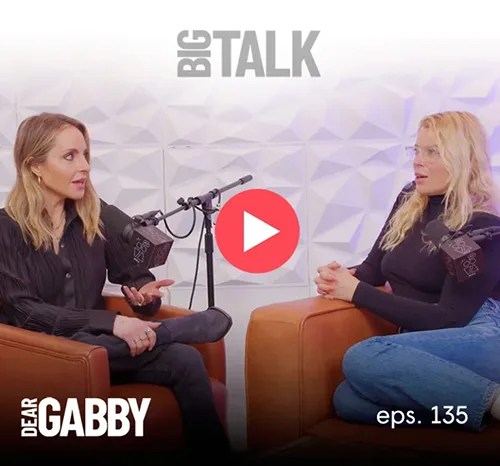
Dear Gabby: The Spiritual Journey of Long-Term Recovery

the truth about long-term recovery

When I think back to the woman sitting there 15 years ago in a place of total dissociation, I realize she was exactly where she needed to be. If she had known any more or had pushed any further, it would have blown her out.

Here’s what I want you to know:

today, you are exactly where you need to be

Trust that your recovery is happening at the right pace and open up to whatever support you need now.

The long-term recovery and the momentum Amanda created around her spiritual and sober condition were like a pillow she fell into and returned to at the right time.

Your next level of recovery will become available to you if you hold onto that curiosity and willingness to grow. It may take different forms—12-step recovery, online programs, support from the right people—but it will be there at the right time. 

That’s the beauty of the journey.

Even in the midst of a crisis, years after she got sober, it was Amanda’s long-term recovery journey that kept her moving forward, she said. 

The invitation to continue to grow will keep presenting itself. If you have the willingness to heal and the curiosity to grow, you have to continue to nurture that part of yourself, no matter what anybody else says.

This frank, honest, deep conversation between spiritual sisters on a journey toward long-term personal growth has so much to offer anyone on a healing path. 

following your path

In our conversation, Amanda shares beautiful insights on: 

  • Sobriety and long-term recovery 
  • Navigating grief and loss
  • Nurturing relationships with like-minded people

Our talk was a powerful reminder that sometimes our most challenging moments are our greatest opportunities to deepen our spiritual connection.

Here’s what she had to say about the journey toward healing:

Life continues to crack me open. In those moments, I am faced with turning away from my recovery or leaning into it even harder, with more commitment.

get more gabby

free manifesting meditation to attract your desires

By submitting your number, you agree to receive recurring automated promotional marketing text messages from Dear Gabby, Inc. and Gabby Plus, Inc. at the cell number you entered above. Consent is not a condition of any purchase. Reply HELP for help and STOP to cancel. Msg frequency varies. Msg and data rates may apply. You also agree to our Terms & Privacy Policy.

disclaimer

This podcast is intended to educate, inspire, and support you on your personal journey towards inner peace. I am not a psychologist or a medical doctor and do not offer any professional health or medical advice. If you are suffering from any psychological or medical conditions, please seek help from a qualified health professional.

dear gabby #135 May 01, 2023 manifesting 32 min

the spiritual journey of long-term recovery

Listen on:

The following podcast is a Dear Media production.

Hi there, Gabby here. This podcast is intended to educate, inspire, and support you on your personal journey towards inner peace. I’m not a psychologist or a medical doctor and do not offer any professional health or medical advice. If you are suffering from a psychological or medical condition, please seek help from a qualified health professional.

May is Mental Health Awareness Month, and it brings me to wanna engage this audience in supporting an organization that I am 100% behind. Several months ago, I joined the board of McCall Behavioral Health Networks, and they specialize not only in substance use disorders, but mental health disorders as well

Often, these co-occur, and we talk about that a lot in the show, and I’ve been very open for a while now about my 17 and a half years of recovery. Over the years, I’ve spoken at dozens of organizations. I’ve been involved in a lot of different recovery communities, and I believe really wholeheartedly in this organization.

McCall Behavioral Health has over 50 years of experience treating mental health disorders and substance use, and their mission is to inspire hope and promote wellness, which is very much in alignment with mine.

And one of the most amazing things about this organization is that they support everyone’s journey to healing. They never turn anyone away, and that is probably why I have to stand behind this organization most. They’re never turning anyone away for their inability to pay, and so that’s where donations come in.

I’m inviting you today to make a donation to McCall Behavioral Health Network. Like I said, they never turn anyone away. And the more money that they can raise, the more people that they can support. And if you walk through their doors, you will receive services, period. So that’s why I’m asking you to consider donating today.

If you can, please go to deargabby.com/donate. Even if you can just donate a dollar today, that will make an impact. So here we are. This is Mental Health Awareness Month. There’s a lot of need and if you can, donate a dollar, donate more. Whatever you are comfortable with, head over to deargabby.com/donate to give today.

Hey there. Welcome to Dear Gabby. I’m your host Gabby Bernstein, and if you landed here, it is absolutely no accident. It means that you’re ready to feel good and manifest a life beyond your wildest dreams. Let’s get started.

Welcome back. Welcome back, my friends. The show today is why I named Big Talks: Big Talks. It’s a true big talk in every sense of the word. I was really thrilled to have a reconnection to an old friend, my friend, Amanda DeCadenet. She is the founder of the podcast, the Conversation, and she’s also a very spiritual woman who has a lot of wisdom to share.

And when we initially sat down together, there were so many things that I wanted to talk about, but I opened the episode by sharing something extremely vulnerable, something that was a story between us that at the time was very shameful. Something that I carried silently for many, many years, and I share about an interview that she did with me decades ago and some real regretful things I said on that interview, and I was really honest and set the tone for a very frank conversation, a very vulnerable conversation.

And in that conversation we were able to expose so much of our own recovery and open up about our own grief and our own experiences in our sobriety, and that vulnerability at the top of this episode was the catalyst for a very intimate conversation. You’re gonna really wanna listen to this one, so keep listening, listen all the way through.

Amanda is profound. If you love her and you love this episode, definitely go out and listen to her podcast, The Conversation. Enjoy the episode now.

GABBY: Amanda’s in the house.

AMANDA: I am. I’ve come to see you, my friend Gabs, my longtime friend.

GABBY: This is a really important episode that I’ve been wanting to do for a long time and it’s something I’ve been thinking about for a long time, and you are someone who has been very significant to me. Even though we’re not close friends, you’ve had a lot of significance in my life.

And from a long way back too. What, like 15 years?

AMANDA: Yeah, 15 years.

GABBY: 15 years. I wanna open by sharing our story.

AMANDA: Yes.

GABBY: Which is a story that I’ve honestly never spoken out loud. Maybe I told Joshua before this episode, but it’s not something I’ve actually spoken about much. And it’s something that there’s a lot of shame in it.

And it’s crazy and sort of opening me to witnessing a young part of myself that was so dissociated and checked out. So backstory, we meet for the first time. I think it was the first time we met. When you had your show, you had a show What? What network was it on?

AMANDA: It was on Lifetime.

GABBY: You had a show on Lifetime that you were producing with Demi Moore?

AMANDA: Yes. The Conversation.

GABBY: The conversation, and it was this very like ahead of your time, kind of show where you would sit down, only big talk. Just like I like it. And just get into it with all kinds of people. And you had these crazy celebrities. You had Lady Gaga, you… Who did you have on the show?

AMANDA: Oh my gosh, Alicia Keys, Lady Gaga, Gwyneth Paltrow, just so many amazing women. There’s a long list.

GABBY: And then for some reason you decided to invite me to be on the show. And this is 15 years ago. I don’t really know where I was at. My career was just sort of budding. And so you can imagine it was a big deal for me to get that call.

AMANDA: Well, you were also ahead of your time with what you were doing, right? So I’d been in recovery a long time. As have you. And there were not many people who were speaking with the perspective that you had at that point.

GABBY: Yeah.

AMANDA: And there weren’t people who were speaking with the perspective that I had at that point in a public forum.

And so I knew who those women were. And they were few and far between. So you were on my radar as someone who I wanted to speak to because I knew that you would be willing to have a conversation with me about real s**t basically.

GABBY: Great. Okay. So I’m in this place where I’m like, wow, okay. I’m being asked to do this thing.

I was probably in my late twenties, early thirties, probably at that point. And I was definitely a little bit starstruck and kind of like, I’m showing up for this thing at your house and got my makeup artist and the whole thing, and I sit down with you and we do this interview and everything seems to be going okay.

And around that time I was deep, deep, deep in A Course in Miracles and deep in the work of Marianne Williamson and really trusting in this one mindset, which is like very direct. It’s only love is real. Only love is real and that the fearful experiences that we have in our life are all based on our detour from fear.

Our dissent from magnitude into littleness and from a spiritual perspective that made sense and that has merit. But when it’s spoken about in a way that’s just cavalier, it can be really offensive. And so we’re sitting there and we’re having this interview and you say, I don’t even know how it happened, but I said something about really believing in fear and how fear takes us out, but that doesn’t matter what happens to you. That whatever your situation could be, it’s the same issue as the same fear response.

I said very casually, like a woman being raped could be having the same fear response as somebody who was bullied in high school or it was something like that. And the second I said that I, and at the time had no idea that I had any sexual trauma or anything. The second that I said that, I felt the whole energy in the room tank, I think I saw Demi’s face was like, woo.

And your response was so hardcore and brave, and you were like, uh, well that’s my story, bitch, you know. And you actually handled yourself really beautifully, but you came right back and you were like, whoa, that’s my story. And like, I don’t think you have any, any idea what the fuck you’re talking about. So ultimately we carried on with the conversation.

You were very gracious. You took photos, da da da. As you can expect, this episode did not air. Mine did not make the cut. And I knew from the moment that I said that, that was just not on track with what I was trying to say, but also just very ignorant and cavalier. Fast forward a decade later, maybe longer, we’re on the phone just having a conversation and you were cool.

You stayed my friend. We still collaborated in ways like you were cool. You weren’t like, I’m gonna write her off. Like, you kind of just saw it like, okay, she misspoke, but I’m not gonna…

AMANDA: Totally.

GABBY: I’m not gonna not be friends with her. Yes. And you were very supportive of me. Dot dot dot. Fast forward a decade later and we’re on the phone and we’re talking, and it was just around the time that I had remembered being sexually abused as a child. And that it was so dissociated.

And on that call, I came out and I was like, Amanda, I had no idea that that was my truth. And I was in such a dissociated state that I could even speak about those types of things without any emotion or any connection at that time, because I was so and checked out about it. And I apologized to you.

AMANDA: You did.

GABBY: And was able to just be in a really beautiful, one of the more beautiful conversations of my life. I can see it. I’m like, it was in my kitchen on the sofa talking to you, and it just went on and on and on.

And it really just opened my heart—one, to you for having the grace to be able to carry on a friendship with me, even in the midst of some of that discomfort, but also for myself, just looking back and having so much compassion for that 30-something girl in that room who was just so in her dissociated state, so checked out, so removed from reality and looking for spiritual answers, but not understanding that there was therapeutic healing that had to occur.

AMANDA: Thank you for sharing that story. It’s a very vulnerable and brave story to share with your listeners.

And I think it’s really important to share because you are someone who walks the talk, and it is why I’ve always been drawn to you as long as I’ve known you because you are a woman like I who have lived through these things and who is struggling to find answers and solutions the same way that your listeners are and the people who are drawn to you. And it’s the same path that I walk. Like you cannot transmit something you don’t have. We know that from recovery. We can’t give anything to anyone else that we don’t already have for ourselves and we haven’t already experienced.

And for me, that moment with you interviewing you, I as a survivor have a lot of compassion and understanding that healing is not linear.

And that what you said was something that came from a place of you hadn’t got…

GABBY: Ignorance. A place of ignorance.

AMANDA: Yes, a place of ignorance and also just lack of awareness and I never want to shame anyone for that because I know for me, there have been countless times in my life where I have lacked awareness and people have given me the grace and the space to allow for that.

And fundamentally, when we talk about supporting women, the reason I chose not to air that interview was because I felt protective of you.

GABBY: Yeah, totally.

AMANDA: And I felt like I wanted to shelter you from any criticism that you may have gotten from saying that. And I understood it, but I knew that if that went out in the world, that could cause harm for you.

And I didn’t want you to experience that.

GABBY: It’s interesting that you say it cause I remember feeling like, oh, thank God that didn’t air. There was this ego part of me that’s, oh wait, but that’s such a big show and I wanna be part of it. But then there was this truth that was, thank God that didn’t happen.

[AD BREAK]

Life moves fast. Starbucks’ ready-to-drink coffee delivers an uplifting boost that helps you tune into the moments that matter—wherever you are. I’m a big coffee drinker. People. I don’t understand. Those of you that don’t drink coffee. I love you. I forgive you. I have compassion for you, but I don’t understand you.

I love my coffee and it’s a huge part of my morning routine, and I am so busy most mornings because I’m trying to get a four-year-old dressed, fed, out the door to get to school. We have a twenty minute drive to school. It’s a long morning, and if I don’t have my coffee, it’s gonna be an even longer morning.

And Ollie, he always says, mama, you need your coffee. And that’s why I love this new conveniently packaged coffee on the go. Starbucks is making it happen for us. They’ve got ready-to-drink coffee right within reach, and I can get that little uplifting boost moment the that I need it and never break my flow.

I don’t have to stand over the coffee machine. I can just get my coffee, go in and walk out the door. I just grab that nitro cold brew. Grab Ollie. Grab his backpack. Put on some Lady Gaga and we’re good to go. And there are so many good choices like Starbucks Frappuccino Chilled Coffee Drink, which is inspired by Starbucks Cafe favorites, and it comes in four delicious flavors, mocha, vanilla, coffee, and caramel.

I’m obsessed with the Nitro Cold Brew. I love it. I love it. I love it. It’s in my fridge and I grab one and I go. So enjoy every moment with Starbucks ready-to-drink coffee. Starbucks Coffee, ready for right now. Shop the full lineup online or in stores, wherever you buy groceries.

[END AD BREAK]

GABBY: I wanna reflect that a lot of folks I witness now that come on my show that are coming to me with questions about sexuality or questions about their relationship, and I can see their dissociation. I can witness them in their lack of conscious awareness of something that might have happened to them.

And being someone who has had that experience of being dissociated from a memory, now I can see people everywhere. I’m like, oh, fuck, there’s something coming there.

AMANDA: Yeah. Yeah. And that stuff gets revealed to us when we’re ready. And it’s not my job to decide when somebody is ready to see something. I’m not their God, you know? And I think as someone that interviews people, I’ve always been very mindful of not pushing people and asking them too many questions into a direction that they’re not ready to go.

GABBY: Yeah.

AMANDA: Because everyone has their own timing.

GABBY: You’re a master interviewer and you also have this really genuine, almost superpower of being able to connect with people so quickly. And I showed up today only knowing I wanted to start this conversation with that truth and that story. But then I was like, let’s see where, what happens.

Because I trust your energy so much. And I trust your intuitive guidance and where you wanna go.

AMANDA: Yeah. I trust that in myself as well. And the only times in my life where I have gotten into deep trouble has been when I’ve been disconnected from that intuition. And I haven’t had a North Star because it guides me.

It guides me with everything, with work, with friendships, with myself, with my kids, it guides me all the time, and it’s my instinct, my intuition, my higher power, the little voice inside me, and when I cannot connect to that, which is very rarely, it has not gone well for me.

GABBY: What does it take to get you disconnected from that?

AMANDA: A lot of chaos. Last year, I experienced a lot of loss and stress. My dad died. There was a lot of endings and the cumulative losses. My emotion was so intense that it made it very hard for me to connect with that quieter, stiller voice within myself.

GABBY: Well, that makes sense.

AMANDA: Yeah.

GABBY: Yeah. There’s moments in life, there’s seasons in life when you’re gonna have too much noise and too much chaos to even hear that. And I know that, that existing without it for too long is not a good thing. And for me, I have a toolbox that is pretty extensive because I’ve been in recovery since I’m 22 years old. So I have long-term sobriety and all the tools that go with that, and long-term recovery and a lot of outside help.

And I’ve done a lot of work and yet, that when there’s so many stresses, none of the toolbox seems to work. And only in hindsight are you able to go, wow, what kind of state would I have been in without all those points.

GABBY: Correct, correct, correct, correct. And also maybe it took you a year to get out rather than the lifetime.

AMANDA: Exactly, yes. Yeah, and that’s what I know to be true at this point.

GABBY: Yes. Yes. You and I both have a very common thread, which is our recovery. I was 25 when I got clean. You were 22 for some reason. I thought you were much younger even.

AMANDA: So I got sober at 19, but I didn’t get into active recovery till I was 22.

GABBY: Okay, cool. Got that. All right. And for you and for myself, I know that we both cherish our recovery.

AMANDA: Yes.

GABBY: Share with me anything you wanna share about that. What’s that mean to you?

AMANDA: Recovery is exactly what that word means to me, which is to recover from a mindset that was seemingly hopeless for me.

Um, I am so grateful that I found sobriety at a young age because I am the product of recovery. Like everything in my life is due to recovery. There’s not one single thing in my life that is there without recovery. And I know that to be true today. My friendships, my career, my relationships, the way I parent, the way I’m a partner, the way I show up in the world is guided by recovery still to this day.

I have an amazing support network. I have a group of women who I meet with weekly who I’m on a daily tech thread with. I have guidance from women who are older who have more recovery than I do that I check in with regularly. I don’t operate as a solo entity in the world. I operate as part of a community of people who are also trying to be the best that they can and trying to live their lives to the fullest.

And I would never be able to do anything without that safety and also without all of the tools that I’ve been given, cuz I, I honestly felt like everyone got a guidebook but me. Like, how do you do this thing?

You know? And how do people seemingly know how to show up in the world? And they have faith, and they have internal infrastructure, and they have all of this seeming stuff together.

GABBY: Who are these people, Amanda? I don’t know if I know those people.

AMANDA: I, I mean, I don’t, but, but I would meet them and I’d be like, how did you get the guidebook?

And then when I got into recovery, I got the guidebook. And still, even at this point when I hit something, when I experienced something that I have not experienced before, like last year my dad died. I never experienced death of someone that I love before. Not in this capacity. And it was like entering into a room and having to speak a language that I had never heard before.

GABBY: Right.

AMANDA: The language of death basically, and everything that goes with that. And luckily I have a community of women that I can go to and say, who’s experienced this?

GABBY: Yeah.

AMANDA: And somebody in my women’s group, their wife is a death doula.

GABBY: Oh wow.

AMANDA: And so as this started to unfold for me, someone in my group was like, you should speak to my wife.

And their wife became a guide for me through the process. And I am divinely protected and guided throughout whatever happens. And I have been in recovery long enough to know that is true.

Even when I don’t feel it or see it. I can look back afterwards and go, wow, I was held.

GABBY: Yeah. And just to deepen the conversation about what recovery means to us, I would say that I would often feel like when I’d meet people, maybe five years into sobriety, be like, I wish you could find this.

Yeah, I wish you could have this. And then I now, today, fast forward 17 and a half years of sobriety, I speak at a recovery center. And when I speak there monthly, I’m looking at this room of people and I know that this is hard for them to accept in the moment, but I’m letting them know. I’m like, you’re the lucky ones.

AMANDA: Yeah.

GABBY: You’re gonna get the guidebook. As you would say. And those humans that don’t hit necessarily such a huge bottom, don’t have that moment of cracking open to what’s possible. And so, there’s the guidebook, there’s the spiritual foundation, and that then I think opens so many other doors for recovery.

AMANDA: Yes, it does.

GABBY: When we first started, you said, but does the recovery ever end?

AMANDA: Yeah. I mean, what I was sharing with you was that… What I went through last year, you said it cracks us open. Life continues to crack me open. And in those moments I am faced with, do I turn away from my recovery or do I lean into my recovery even harder with more commitment?

And I’m astounded that I’ve been doing this work for a long time. And yet last year, I hit a point where it felt like I knew nothing. And I couldn’t believe that I was still dealing with some of the same issues. That I was dealing with in my first five years of recovery, and I did a series for The Conversation, which I now do as a podcast.

And I interviewed people like Gabor Maté and a amazing therapist I love called Terry Real and a amazing man called Yung Pueblo. And I did a series with people whose work I was very connected with at that time, and I was asking everyone. Is it possible to ever heal wounds so that you don’t have to do so much work on them?

And it’s specifically Gabor, right?

GABBY: Yeah. What did Gabor say?

AMANDA: He said, well, we wouldn’t be having this conversation otherwise. I believe him because I trust him, but I’m not there yet. And I don’t know if there is ever a point where, as we say, in recovery, you know, resting on our laurels. As you said, there are seasons, right? Where you’re really in the trenches and there’s a lot of work to do, and you’re just, every single day just trying to like move through it and learn and grow and heal.

And then after that you have periods of time where it’s like a little smoother and then life is in session. Something else will happen. What I do know is that the invitation to continue to grow continues to present itself to me. Right? And I, like you am someone who is very committed to walking the talk, and I don’t ever want to be in a position where I’m talking about things that I haven’t experienced or I’m not experiencing myself.

I can’t talk about something that I don’t have experience of.

GABBY: Yeah. No. You can give an opinion, but you can’t. Yeah. Yeah. I think that what I’m hearing also is, is that sort of acceptance of, okay, show me what you got that willingness to continue to grow. I can say though, from the response that Gabor gave you is that there is true recovery that you are completely aware of in your own world, in your own internal system. And so when we kind of lean on that spiritual proof of that recovery, it just keeps us wanting more.

[AD BREAK]

Our next partner is Athletic Greens. I’m just gonna say AG-1 by Athletic Greens. It’s amazing. It’s amazing. And earlier I was talking about my coffee ritual, but there is one ritual that comes before my coffee, just one. It’s my AG-1. I have a very intense journey that I’ve gone on with my gut and I want to set my gut up to win every single morning.

And so that’s why I love Athletic Greens because the product is so supportive to my gastrointestinal system and it supports my immune system, and it gives me a lot of energy as well. And so, get this. It also really tastes good. I take AG-1 and it makes me feel like I’m doing something good for my body and covering all of my nutritional bases.

And I usually start my morning with this tall glass of water and I mix in the AG-1 before I even reach for my coffee. And it’s just one scoop of powder mixed with water once a day. It’s a really seamless daily habit. It helped improve my digestion, it gave me more energy, and it made me feel like I was ready to take on the day.

So just one daily serving supports my long-term gut health with 75 high quality vitamins, minerals, and whole food sourced ingredients. AG-1 is not only the best all-in-one solution for daily nutrition, it saves you time, confusion, and money. Each serving costs less than $3 a day.

So if you’re looking for a simpler and cost effective supplement routine, Athletic Greens is giving you a free one year supply of Vitamin D and five free travel packs with your first purchase.

Go to athleticgreens.com/gabby. That’s athleticgreens.com/gabby. Check it out.

[END AD BREAK]

AMANDA: There are times like going through the death of my dad.

GABBY: Yeah, let me take a moment there because I didn’t know that and I just wanna acknowledge that and just give you a lot of love and compassion and I also just wanna acknowledge that it’s a beautiful thing to have loved in that way.

AMANDA: Yes, it really is. And thank you for acknowledging that. You know, my dad was my first attachment wound as dads are for many daughters. And so it was an opportunity to really heal some residual attachment wound issues. And I found it necessary to really carve out some dedicated time to heal those places in me that cracked open in a whole new way from the death of my dad.

GABBY: What did you do?

AMANDA: I took about two weeks and I went and did a grief and trauma workshop and intensive, and it was really healing. It was very powerful. It was very uncomfortable, but I have enough recovery to know when I need extra support.

GABBY: Yeah, yeah, yeah.

AMANDA: And I encourage anybody who is feeling that they need that container to do focused work, to find a place that they can do that.

There’s so many amazing places, and I’m so grateful that I live in a country where there is the opportunity to find a place that does trauma and grief workshops.

GABBY: Do you mind sharing where it was?

AMANDA: It was a place called Driftwood. Which is in Austin.

GABBY: Oh, beautiful.

AMANDA: And I looked at Onsite. I’ve done the Hoffman process a couple of times, so I had done a lot of work there and it was an amazing opportunity to really have some focused, dedicated healing time that I needed.

To me that’s recovery is when we’re able to say, okay, all my tools I don’t feel like are carrying me through. And I know that this is an invitation to heal in a deeper way. And I’m going to take the invitation because if I know anything, it is that if you ignore the invitation and you really do need to address something, the universe will just knock louder.

And I didn’t wanna see what the next knock was.

GABBY: No.

AMANDA: I was like, no, no, I’m good. I’m going. I’m gonna pay attention here.

GABBY: Yeah. And I think about the person who’s listening that they’re like, okay, well I can’t afford a recovery treatment center or whatever. Your next level of recovery is available to you in whatever form you can take.

AMANDA: That’s right.

GABBY: So if it means getting into a 12 step meeting or if it means going and even just practicing the principles of a self-help book. So taking that time and that space in whatever form is available to you.

AMANDA: Yes. There was online workshops as well. That was programs online where you can work through a whole course online.

Which I also did. I…

GABBY: What was that? Do you wanna recommend that?

AMANDA: So, you know, one of the things that I was looking at was how my attachment wounds specifically in regards to my dad and to men was showing up in my marriage. And there’s a wonderful therapist called Terry Real, and Terry has online programs.

And so I did one of his courses.

GABBY: Cool.

AMANDA: And I found that really helpful. And so I think it’s, wherever you’re at, you can find something, as you said.

GABBY: Right. Now, with that new awareness from the work that you’ve done, how do you think you’ve come out from that?

AMANDA: I think that it recalibrated me in a way that was really necessary.

I think that when you go through something traumatic and you feel like you’re not on steady ground at all, you feel like, wow, everything has changed.

Because experiencing a death, for me, it was like I entered a room I had never been in before. And I had to learn a whole new way to be, and I had to deal with this intense loss and grief that I had never experienced before.

I think it helped me integrate those experiences so that they’re now a part of me and allow me to bring that experience into myself in a way that wasn’t shocking. When you first experience something, it’s a trauma. Experiencing a death of a loved one is a trauma.

GABBY: Yeah.

AMANDA: And I was able to process that trauma and really find the gifts and the beauty in it as opposed to just the initial impact of the shock of it. And so it’s really about integration where it isn’t something that’s jarring you. It’s a part of me now.

And it just gave me the space to do that. Where I could really integrate and give myself the time to do that, and I was really proud of myself for doing that.

Because as someone who does have long-term recovery, being able to say, okay, I need to take two weeks out of my life, my husband, my kids, guys, I’m not gonna be with you. I actually need to take care of myself. And that was role modeling for my kids that you may find at some point in your life, you need to do that for yourself.

GABBY: Yeah. Yeah.

AMANDA: And it’s okay to do that. It’s more than, okay, that is recovery that is showing up for yourself.

GABBY: Yeah. And I think that that listener that has that experience of being like, well, I can’t do that. Even that moment, even that hour in a meeting or that 30 minutes listening to a meditative story that’s gonna support your alignment—that adds up.

AMANDA: Well, that’s what I did for the whole way through the process of my dad when he was diagnosed to when he passed. Yeah. I’ve never taken two weeks away from my children. Yeah. I’ve never even taken a week. My kids are 16, so it was a massive thing for me to do and I really didn’t want to do it because it was not convenient, I can tell you.

But what I did do is that I did listen to wonderful teachers talking about the experience of death. And I have apps that I listened to, things I did meditations, I listened to music, I listened to people’s stories. You know, I did everything that I could do to keep myself in a place of moving forward until I realized that is not cutting it.

And I need to give myself that time.

GABBY: Yeah, yeah. Good for you for realizing that you needed to step away and do that time.

AMANDA: Oh man. I thank you.

GABBY: I always like to come to these sort of teachable moments in these conversations, but knowing when it’s your moment to step away.

AMANDA: Yes.

GABBY: We’ve kind of also captured acceptance that recovery is a ever-present experience that can consistently show up for us in any moment, big or small. To celebrate that in a sense. Because, just like I say to the sober folks, when I step into that recovery center, I’m like, you’re the lucky ones.

There’s a lot of people walking around out there that are completely disembodied. Totally. Just walk around like robots. Maybe they haven’t hit a bottom, but they’re not living in their full, authentic truth, they’re not living in what’s truly possible.

AMANDA: Yes.

GABBY: And so for those of us who are listening to a show like this, we’ve had a, an opening, and obviously you and I sitting here have had a lot of opening moments to crack us open to what’s possible, but accepting that with some gratitude.

AMANDA: Yeah. And there was a lot of moments where I did not feel grateful, where I felt like this is so painful and so brutal, and I had many moments of like, why is this happening to me? Why am I having to deal with all of this stuff? I had multiple things happening at the same time that all funneled into the kind of loss bucket.

Not being in gratitude is just so much harder. And yet, how do you get back into gratitude? I’m part of a group of women who does a daily gratitude list on a group chat.

GABBY: Yeah, cool.

AMANDA: It’s awesome. There’s 18 of us, and…

GABBY: You just drop your gratitude.

AMANDA: You drop it in every day. And so I get to read everybody else’s.

And then I’m like, okay, I can, I can come up with something. You know what I mean? And so I think community of like-minded people is so crucial. Just the reminder that like, we’re not doing this alone. We don’t have to do this alone. There are other people. It’s why when you and I first met and why we’re not close friends, but you and I are connected.

We can pick up wherever we are in our lives. And I know that we have connection points because we appreciate that we don’t do this alone.

GABBY: Mm-hmm.

AMANDA: And the value of sharing our stories with each other helps us all on the journey. Because we’re not alone.

GABBY: I often joke that I became a motivational speaker because I wanted to be with people that were like me. I wanted to make friends.

AMANDA: Totally.

GABBY: And it’s so true because it’s that connection. I mean, that’s probably why you had your show. You’re like, I just wanna have big conversations with people that wanna talk about big things. And it’s this experience of recognizing that when we start to let other people in, and we start to celebrate in our gratitude, then we allow it to multiply and love multiplies.

AMANDA: It does, and there’s a very special kind of love that I feel for people who are also on this path. I feel very grateful to be able to, for want of a better word, mentor women who are earlier on in their recovery process. And those women are like the light of my life. And you know, seeing those women grow and their lives unfold and become right size in the most authentic way to them, it brings me such joy.

You know, it’s a kind of love that for people who are not in recovery, I know, like my husband will look at those relationships and he’s like, you’re so bonded to each other. And it’s not like we speak every day or, but we just share a common goal. And I think there’s something really powerful in that.

GABBY: Yeah. So if you had a chance to mentor right here, right now on Dear Gabby, a young woman who’s, or a man, cause there’s all kinds of listeners here that’s out there struggling with addiction, struggling with their mental health. What would be the one thing you’d want them to hear from you?

AMANDA: Well, the one thing I would want them to hear is, the only thing that you need to begin your recovery journey is willingness.

That’s it. When people ask me to mentor them, the only thing that I ask is, do you want this or do you need this? Because if this is like a matter of life or death for you and you’re like, I’m at the end of my rope here, I gotta make some change. I’m interested, I’m available, I’m open.

Reach out to me. That is the only thing that I’m really interested in, because you have to have willingness again and again, and again, and again and again.

GABBY: I love that question so much. Do you want this or do you need this? I’m actually mentoring a young woman in recovery recently, and I’m not sure she wants it.

AMANDA: Right.

GABBY: And I’m gonna ask her that. That was really helpful for me. And that’s really important for anyone listening too, because what works is the willingness.

AMANDA: That’s right. And you have to continue to have willingness with long-term recovery. What is that through line? It’s that I’m willing, I am willing to go to any lengths to be whole.

I am willing to go to any lengths to be free from the bondage of my insane brain. I really am.

GABBY: Also trusting that there’s this sort of guided cadence through our recovery. Because I can just speak for myself and kind of as we wrap this back to where we started. If I think back to the girl sitting with you 15 years ago, roles reversed, you’re interviewing me.

And I’m in that place of total dissociation. She was exactly where she needed to be then.

AMANDA: Yes, she was.

GABBY: And if she knew anymore or if she had pushed any further, or if anything had been revealed sooner, it would’ve blown her out. And so to trust in the pace of your recovery.

AMANDA: Yes, absolutely.

GABBY: That God won’t give you anything you can’t handle.

AMANDA: That’s what they say. And honestly, I know that, and I have been told that, and I’ve experienced that so many times, and yet last year I was like, okay, come on. This is a bit much. This is a bit much. You know?

GABBY: But really, what did it do? It just upleveled you more.

AMANDA: That’s right.

GABBY: It just, it just brought you to the next space of your recovery, your development.

AMANDA: And I will say it was a time in my recovery where I really wasn’t sure what the other side looked like. And that was really scary. And that was when faith came in, because I couldn’t see it. I couldn’t imagine it. I didn’t know what it was gonna look like.

I didn’t know what the other side meant when if, how I, I didn’t know. And that was where my faith really got tested.

GABBY: Yeah. And I wanna close with this thing that you said that was so valuable for our listener, and that is that the long-term recovery and the momentum that you created around your spiritual condition, around your sober condition, the community that you created, was there, it sounds to me like this pillow that you fell into…

AMANDA Yes.

GABBY: …in the midst of this crisis, and so while, even though you might have been completely shocked, like you said, and taken out. You actually can’t even imagine what it would’ve been like if you hadn’t had that long-term recovery.

AMANDA: I cannot. The only thing that could be worse than what I was experiencing was to not have experienced it sober there.

GABBY: There you go. Right.

AMANDA: That was it. I was like, there’s nothing worse than this. Other than not being in recovery and not being sober and not having that support that I had. I didn’t even think what it would’ve looked like, to be honest.

GABBY: Right, right. So as we kind of end this conversation that I feel like needs to go on for another 10 hours, and I definitely wanna have you on this show more often because I just like being with you and I feel there’s like a real nice synergy that’s always been there.

And now in particular. What would you like to leave us with?

AMANDA: If you’re listening to this, you obviously have willingness to learn and to grow, and you have curiosity and nurture that part of yourself no matter what anybody says.

GABBY: Amen. Yes. If you’re still listening right now, you have willingness. Big time.

You’re still listening. Yeah. And the curiosity and continue to nurture that. I think that is so profoundly beautiful. Nurture the willingness and curiosity.

AMANDA: Yes. That’s so valuable to have. You know.

GABBY: Beautiful. Thank you. I love you. Thank you.

AMANDA: I love you, Gabs.

GABBY: So everybody can go listen to The Conversation when it’s back on the air.

AMANDA: It’s coming back on this week. I have, my first episode is with Jamie Lee Curtis.

GABBY: Oh yeah. Girl.

AMANDA: Who? Right after she won her Oscar. Another woman in recovery. And she shares some phenomenal insights about the reality of what it’s like to win an Oscar. It was like right afterwards that we did it.

GABBY: That’s so awesome. Yeah. Okay. And that’s out now. The Conversation with Amanda DeCadenet.

AMANDA: Wherever you get your podcast.

GABBY: Wherever you get your podcast, people go, listen, go listen. I love you so deeply.

AMANDA: Thank you.

If you made it to the end of this episode, that means you’re truly committed to miracles. I’m really proud of you. If you wanna get more Gabby, tune in every Monday for a new episode.

Make sure to subscribe so you don’t miss any of the guidance or special bonus episodes. Your experience at this show means a lot to me, so I really wanna welcome you to leave an honest review and you can follow me on social media at @GabbyBernstein.

And if you wanna get in on the action, sign up for a chance to be Dear Gabby’d live deargabby.com. See you next week.

Please note that this episode may contain paid endorsements and advertisements for products and services. Individuals on the show may have a direct or indirect financial interest in products or services referred to in this episode.